Tony Rudenko sent me pictures of 2 variations of the TL-122-A that I hadn’t seen before:
There’s a TL-122 (no suffix) type number which is stamped into the housing. The number is not set in a circle, as is usually the case. This version has metal wedged around the glass so there is no way to replace it with a new one. The lens ring with its ribbed rim is unlike the two other types in my article about the TL-122s.
Another difference that really stands out is the belt clip. It is attached to the back with to rivets, but it also extends to the top, where I think it is also rivited.
It takes a regular threaded bulb (as do the other TL-122s).
And there’s one that looks like a TL-122-A, but is marked No. 709. Never heard of this type designation before. But other than that this flashlight looks like a regular TL-122-A. It is painted OD green and the the brand is Niagara, which was one of the military contractors. I also have a later plastic TL-122-D made by Niagara.
The only thing besides the type no. that differs from other TL-122s is the switch.
The AN/CRN-4 beacon was reportedly used in Bastogne, but I can find no photographic evidence or first-person testimonials of it. My interest in this topic was renewed when reading “Bastogne” by Peter Schrijvers and finding an original 1944 handbook of the AN/CRN-4. This gives a more detailed look at the beacon’s components, such as the transmitter, the battery, the antenna and padded bags. As far as I can tell, the well-known photo of a beacon in use at Bastogne (right) is not a CRN-4, but a PPN-1. I can tell by the typical shape of the antenna compartment of the drop bag and the antenna. Both the bags (2) and the antenna of the CRN-4 look much different.
101st Airborne Pathfinder PFC ‘Jack’ Agnew kneels atop a brick pile within the Bastogne perimeter, as he activates a Eureka beacon to guide in the first wave of C-47s during the re-supply mission on December 23, 1944.
Here you can see a picture of the CRN-4 in its complete setup with 2 large antennas connected with wires and a grounding antenna laid out in a star shape on the floor.
However, this isn’t the only rare type of beacon that I have found wartime dated manuals for. Next to the better known AN/PPN-1 and PPN-2 Eureka beacons, the United States developed other portable radio beacons for guiding aircraft to drop zones. The PPN-1 was used in all WW2 operations. The PPN-2 was only used in Operation Varsity. The PPN-1 is very rare and only a handful of sets (if that) are known to have survived the war. PPN-1 accessories are also very rare. The PPN-2 is also quite rare and expensive, but more of these survived.
Cover of the AN/CRN-4 handbook of maintenance instructions
BUPS antenna, PPN-1 replica and PPN-2
The so-called BUPS beacon is another mysterious piece. In reference books you will only find the antenna and its padded drop bag. It’s very rare, and I only know of about 5 collectors and museums who have one. But it’s unclear whether these were actually used, and where and how. I have a manual for the AN/UPN-2, as seems to be its official nomenclature, but the antenna itself is unmarked. The advantage of the BUPS beacon is its much longer range than the PPN-1 and 2. The BUPS telescopic antenna is much taller than that of the other beacons. According to literature on Operation Overlord, only 2 BUPS beacons were used on D-Day. I had a video here on YouTube, but unfortunately, it has been removed. When you look at this video, and that’s also what I get from the manual, the BUPS antenna is more like a spool, so not telescopic.
I also have a manual for the AN/TPN-2. This would still qualify as a portable beacon, but it looks much larger and heavier than the PPN-1 or 2 or the BUPS.
As I find out more about this subject, I will dedicated a full article to it. If you have more information, please send me an e-mail.
I got this dvd from eBay recently and I enjoyed it a lot. It’s an old TV movie from 1986 and quite unknown compared to the legendary Patton movie from 1970, although George C. Scott plays general Patton in both.
As the title suggests, this movie starts where the other one left off. General Patton got into an automobile accident in Germany, just the day before he was supposed to travel back home to the US. A good part of the movie is set at his sickbed in a hospital. He was paralized from the neck down. His wife comes over from the US and spends the last days at his side. We see flashbacks about his early life. I found it all very moving and a great complement to the first movie.
Especially interesting is the repeated reference to Patton’s conviction that the US should have taken on the Soviets right there and then, when they had the army there. He predicted that within five years, the US would be at war with Russia, but that it would be another kind of war. But the army was largely disbanded in 1945, leaving behind the Army of Occupation. Patton was the last four-star general to leave Europe, and in a way he never left.
Read more interesting facts about this movie on IMDB.
With his Rescued Film Project, the American photographer Levi Bettweiser recently got his hands on 31 undeveloped rolls of film with photos made by the same soldier during WW2. He developed them and we can now be the first people to ever see these photos after more than 70 years. No one has ever seen them before. Not even the photographer!
I talked with Phil Froom almost three years ago. It was about Clayton Hutton’s book “Official Secret”, and look, he’s written his own book now!
Schiffer books are always very beautifully laid out and printed, and they are priced accordingly. But the ones I have are worth the money. So my expectations of this new book are also high. Apart from articles in militaria magazines and on web sites, there weren’t any books that covered this topic in detail. Usually it’s lumped together with other ‘spy gear’ in such books, but this new book is dedicated to British and US escape and evasion items. Clayton Hutton’s book already read like the autobiography of “Q”, but it had very few images. And black and white at that. This new book will have color photos on top!
Maybe you can help me find one. They used to be made by ATF, but they’re all out. I should have bought one 5 years ago when they still had them…
This web site airbornejumpjacket.com has a lot of interesting information about the original, including the pants, which are also different from the M42 pants. The M41 pants were never reproduced by ATF. I remember reading at the time that he couldn’t get his hands on the proper material for it and it wasn’t worthwhile to have it made especially for him.
But it’s just the replica jacket I’m after. So please let me know if you can help.
For all your paratrooper fans wanting to give kids an original Christmas gift, this is the ideal stocking filler!
This brand new parachute toy includes a slingshot launcher – simply fold the parachute and hold onto the paratrooper chest. Then attach the slingshot around the hook on the back of the paratrooper, pull back and fire into the air! Can be used over and over again.
2 years ago, I bought the glider from the same series for my son, and it’s still alive (and I held on to the nice vintage-looking box).
I got this top-qualilty A2 flight jacket from Peter Debrabander of Quarter Master Inspector. I am in love with this jacket! First I was going to get the cheaper cowhide version. That one is fine for re-enactment, but the genuine horsehide version is the real thing. The knit cuffs are red-brown, like the originals, and it even has a Talon zipper with fine detailing. Other original details are the Army Air Forces stamp on the inside of the storm flap and the hook at the collar (although unpainted on the originals). Yes, it’s more expensive than cowhide, but it also looks more expensive. Consider the back is made out of one pristine piece of horsehide. Look at any leather jacket in stores and worn in the streets, and you will be hard-pressed to find one with a one-piece back. That’s because most leather jackets are made of cheaper small pieces of leather, even the ones by designer brands.
Speaking of small… The original jackets were worn quite close-fitting. I first bought a size 42. That seemed to fit alright, but it was too wide at the shoulders and had too much volume at the back. Then I changed it for a size 40, which was still too big at the shoulders. Finally, I changed it for a size 38, and that’s perfect. So I think you should try it on and look in the mirror.
Fury with Brad Pitt is coming out in theaters this week. I had heard about this movie being produced through Combat Dealers on Discovery Channel. This guy Bruce Compton gets called that the production people are interested in using his collection of tanks and vehicles. From this article, it looks like it worked out for him.
This movie marks the first time a genuine Tiger I tank has been used in the production of a WWII film. Fury features “Tiger 131” from the UK’s Bovington Tank Museum, the only fully functioning Tiger tank in the world. That’s a serious step up from the wobbly triplex get-ups we’re used to seeing.
The Main Shermans used in Fury were : Fury M4A2 76mm HVSS from Bovington Tank Museum, M4A2 75mm VVSS from Tay Restorations, M4A2 76mm HVSS from Jeep Sud Est, M4A4 75MM VVSS from Adrian Barrell, M4A1 76mm VVSS. That’s a whole lot of rock ’n roll!
Even though the movie appears to be mostly set in Germany, all of it has actually been filmed in the UK.
I already love Brad Pitt’s M1917 S&W revolver with plexiglass grips in its Mexican-style shoulder rig. He needs to stand out (kinda like his huge bowie in Inglorious Basterds).
I bought this matchbook with ‘para-cutie’ matchbook cover as a fun addition to my collection of smoking items and personal gear to display with my paratrooper collectibles.
This matchbook still has (most of) its matches, which is uncommon, because most people would just collect the covers after the matches had been used.
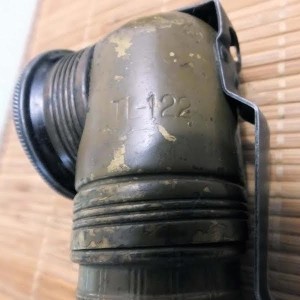 There’s a TL-122 (no suffix) type number which is stamped into the housing. The number is not set in a circle, as is usually the case. This version has metal wedged around the glass so there is no way to replace it with a new one. The lens ring with its ribbed rim is unlike the two other types in my article about the TL-122s.
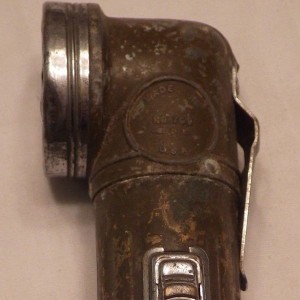 And there’s one that looks like a TL-122-A, but is marked No. 709. Never heard of this type designation before. But other than that this flashlight looks like a regular TL-122-A. It is painted OD green and the the brand is Niagara, which was one of the military contractors. I also have a later plastic TL-122-D made by Niagara.



 I got this dvd from eBay recently and I enjoyed it a lot. It’s an old TV movie from 1986 and quite unknown compared to the legendary Patton movie from 1970, although George C. Scott plays general Patton in both.


